Closure Is a Determination, Not a Guarantee: Reading the Fine Print of a No Further Action Letter
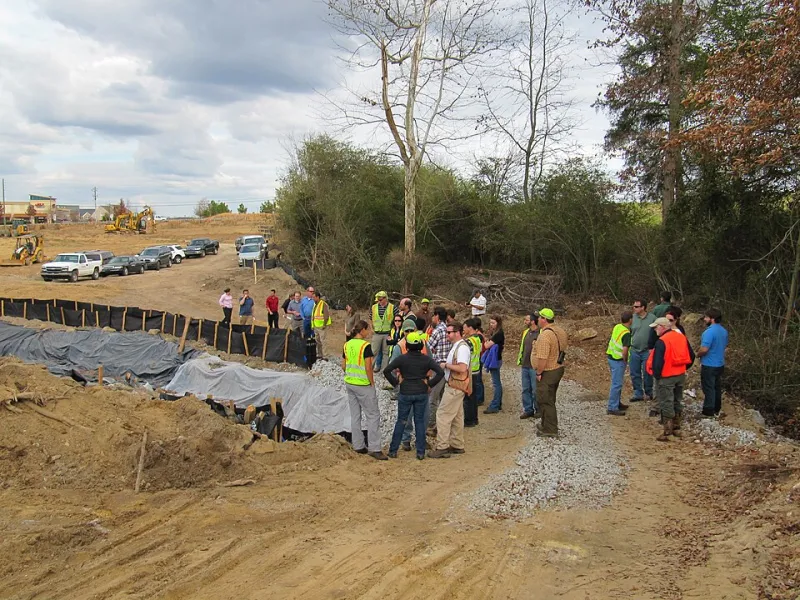
Photo: U.S. Army Corps of Engineers Savannah District, Public domain, via Wikimedia Commons
For an owner who has spent years and considerable capital shepherding a contaminated parcel through investigation and remediation, the arrival of a no further action letter — called an NFA in some states, a closure letter, a certificate of completion, or a release of liability in others — carries the emotional weight of a finish line. Lenders accept it. Buyers accept it. The file moves to the back of the cabinet and the matter is considered settled.
The difficulty is that the letter rarely says what most people believe it says. It is a determination issued by a regulator, under a particular regulatory framework, based on a particular set of sampling results, exposure assumptions, and intended land uses. Change any one of those inputs and the determination can be revisited without anyone having done anything wrong.
What the Letter Actually Certifies
Most closure determinations rest on four pillars: the contaminants of concern identified, the concentrations left in soil, groundwater, or soil gas, the exposure pathways evaluated, and the use the property is expected to support. A letter issued for an industrial parcel with a paved cap and no groundwater ingestion pathway is not equivalent to one issued for a residential subdivision.
When a site's use changes — a warehouse becomes a brewery with a tasting room, a rail yard becomes a mixed-use block, a light industrial park adds a daycare — the exposure assumptions that supported closure no longer describe the conditions on the ground. The letter still exists; its foundation has simply shifted.
Agencies also reserve authority. Many letters contain language preserving the regulator's right to reopen the matter if new information emerges, if monitoring reveals conditions worse than modeled, or if applicable standards change. That reservation is not boilerplate. It is the mechanism by which a file comes back.
The Doors That Reopen a Closed Site
In practice, reconsideration tends to arrive through one of four doors.
A change in standards. Drinking water limits, soil screening levels, and vapor intrusion thresholds are revised periodically. A site closed against a screening level that has since been tightened may find itself above the new number without a single drum having moved.
Newly recognized contaminants. The treatment of per- and polyfluoroalkyl substances over the past decade is the obvious example. Properties closed on the understanding that certain compounds were not regulated have been revisited as analytical methods improved and health-based values were established.
A change in land use. Rezoning, redevelopment, or a new tenant with a more sensitive use can invalidate the assumptions behind a closure. So can something as ordinary as converting a paved yard into a community garden.
Failure of a control. A deed restriction, vapor barrier, engineered cap, or groundwater use prohibition is a promise someone must keep. When a barrier is penetrated by utility work, or a restriction is missed in a title search, the control fails and the exposure pathway returns.
Institutional Controls Are Obligations, Not Footnotes
The most misunderstood element of a closed site is the institutional control. It may appear as an environmental covenant, a deed notice, an easement, or a local ordinance. Whatever form it takes, it usually requires the owner to do something: inspect, maintain, report, notify, or refrain.
These obligations frequently attach to the land rather than to the person, which means they survive a sale. A purchaser who inherits a covenant without knowing it exists inherits both a compliance obligation and, often, a disclosure problem. Title review that stops at the standard commitment can miss an environmental covenant recorded in an unfamiliar format or filed in a separate index.
Reading the File Before Someone Else Does
Owners who want to avoid surprises should be able to answer a short set of questions about every closed site they hold. What standard was applied, and has it since changed? What use was assumed, and does the current or proposed use match? What controls were recorded, and who is responsible for maintaining them? What monitoring, if any, remains, and is it current?
If the answers are not in the file, the file is incomplete. Reconstructing them during a transaction, a refinancing, or a regulator's inquiry costs considerably more than assembling them quietly in advance.
Monitoring as a Quiet Discipline
Not every closed site requires ongoing monitoring, but many do — periodically for groundwater, less frequently for soil gas or surface water. The value of that work is not purely regulatory. It establishes a baseline record showing conditions are stable and the owner is attentive.
An owner who can produce several years of consistent monitoring reports, inspection logs for a cap or barrier, and documentation of covenant compliance stands in a far stronger position than one whose last visit to the site coincided with the arrival of the letter.
Practical Takeaways
Treat the closure letter as the opening of a stewardship period rather than the close of a project. Calendar any residual obligations and assign them to a named person. File the covenant with the deed and flag it in every future title review. Track regulatory changes affecting the standards your closure relied upon. And when a change in use is contemplated, revisit the exposure assumptions before the architect does.
A closed site is not a solved site. It is a site whose risks have been characterized, controlled, and — with attention — kept that way.