One Afternoon of Artificial Rain: What a Simulated Storm Reveals That Your SWPPP Never Will
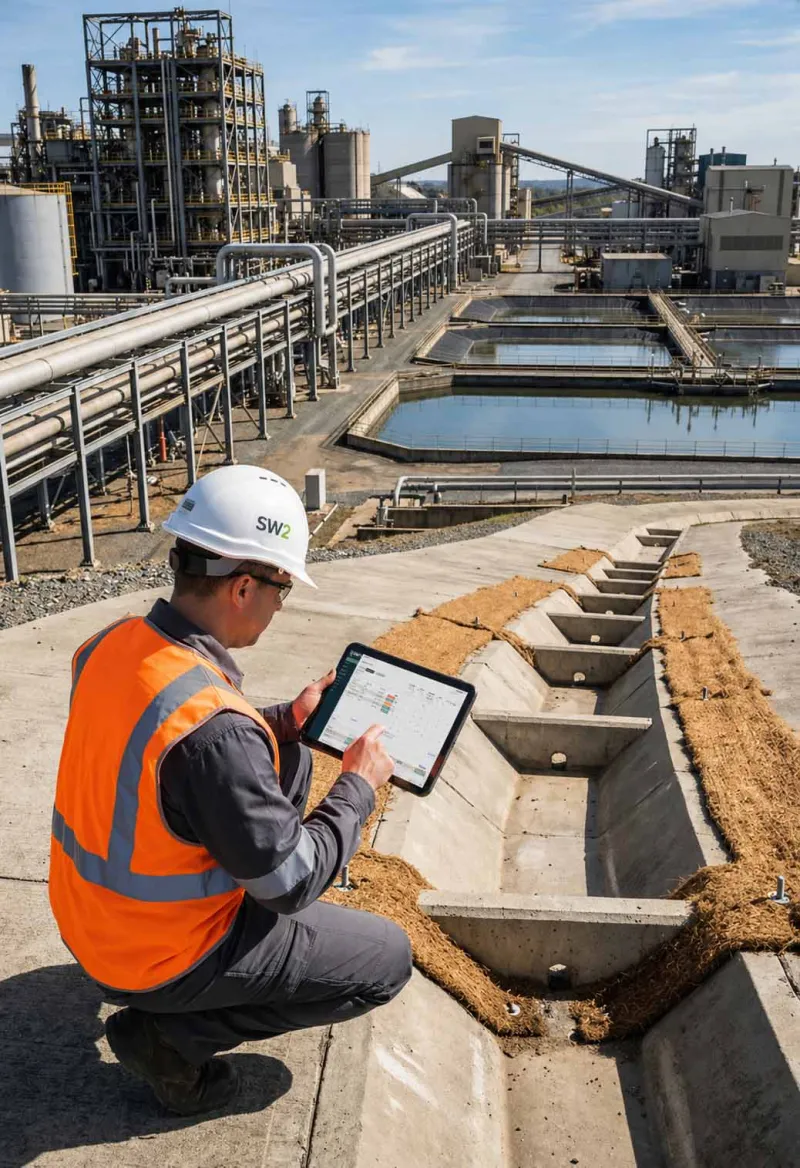
Photo: industrial facility stormwater drainage outfall inspection, via sw2.net
Most industrial facilities in the United States have a Stormwater Pollution Prevention Plan. A smaller number can honestly say they know exactly where every drop of water goes when a serious storm hits. The gap between those two statements is where violations, neighbor complaints, and six-figure cleanup bills tend to originate.
One of the most effective — and least understood — ways to close that gap is a proactive stormwater audit built around a simulated rainfall event. In the span of a single afternoon, a trained team can watch your site behave the way it would during a 100-year storm, and document what your paper compliance file never could.
Why Paper Compliance Isn't Enough
A typical SWPPP is written from site plans, aerial imagery, and an annual walkthrough. It identifies outfalls, lists best management practices (BMPs), and assigns inspection responsibilities. What it cannot show is how water actually moves across a parking lot that has settled two inches since the plans were drawn, or how a silt fence that photographed well in October performs after a winter of freeze-thaw cycles.
Regulators know this. EPA and state inspection protocols increasingly emphasize observed conditions over documentation, and citizen suits under the Clean Water Act almost always begin with an observed discharge — a discolored stream, a sheen on a drainage ditch, a neighbor's photograph. A rainfall simulation lets you see what they would see, on your schedule rather than theirs.
How a Rainfall Simulation Works
The concept is straightforward. Using water trucks, pumps, and distribution manifolds, the audit team applies a controlled volume of water to targeted drainage areas at an intensity calibrated to approximate a severe storm — often modeled on the 100-year, short-duration event for your region. For a facility in the Midwest, that might mean simulating several inches of rainfall per hour across a loading dock apron; in the arid Southwest, the same exercise reveals how rarely-used wash-down areas behave when a monsoon cell parks overhead.
The team then observes, in real time:
- Where the water actually goes. Flow paths frequently diverge from the site drawings. Runoff that is supposed to reach a permitted outfall may instead sheet-flow toward a property line, a storm sewer inlet serving the municipal system, or a low area that has quietly become a wetland feature.
- What the water carries. Visual indicators — turbidity, sheen, foam, sediment plumes — are logged and, where necessary, sampled. A simulation can confirm whether exposed stockpiles, deteriorated coatings, or yard debris are contributing pollutants during actual storms.
- Which BMPs fail under load. A detention basin may handle a light rain but short-circuit during high flow. Inlet protection may blow out. Swales may be undercut. These are precisely the failures that only appear under stress.
- Whether undocumented pathways exist. Aging industrial sites are notorious for legacy drain tiles, abandoned process lines, and outfalls that appear on no current permit. Water finds them. So will an inspector.
A well-run audit typically covers the highest-risk drainage areas in four to eight hours, with findings compiled into a photo-documented report.
Reading the Results: From Observation to Priority List
Not every finding warrants immediate capital spending. The most useful audit reports sort observations into three tiers.
Tier 1 — Active discharge concerns. Any pathway moving pollutants off-site, any undocumented outfall carrying contaminated flow, and any BMP failure with an obvious pollutant connection. These warrant correction on a matter of weeks, not months, along with a written corrective action record.
Tier 2 — Structural deficiencies. Settled pavement, undercut swales, and undersized conveyances that will fail during a major storm. These can usually be scheduled into the next budget cycle, but the record should show they were identified and planned for.
Tier 3 — Documentation gaps. Outfalls missing from the SWPPP, drainage areas whose contributing boundaries have changed, or BMPs listed on paper that no longer exist on the ground. These are corrected through plan updates — often the cheapest and most valuable fixes of all.
The Compliance Value of a Good-Faith Record
Under both the federal Clean Water Act and most state programs, enforcement discretion and penalty mitigation weigh heavily on whether an operator identified and addressed problems proactively. A simulation audit, followed by a documented corrective action plan, demonstrates exactly the diligence that regulators, lenders, and insurers respond to.
It also changes the conversation if a neighbor complains or an agency arrives unannounced. Instead of defending an unknown condition, you are presenting a file that shows the issue was found, prioritized, and scheduled — before anyone else noticed.
A Practical Checklist for Plant Managers
Before commissioning a simulated-storm audit, walk your own site with this list:
- Compare your current SWPPP outfall map against what you can physically find on the ground. Any outfall you cannot locate is a finding in itself.
- Identify your three highest-risk drainage areas — typically loading docks, material stockpiles, and fuel or chemical storage zones.
- Pull the last 12 months of inspection logs and note any BMP flagged as "marginal" or "repair needed." These are your simulation's most likely failure points.
- Confirm water availability and any discharge notification requirements with your treatment operator before the test date.
- Schedule the audit ahead of your wettest season, so corrections can be completed and verified before the real storms arrive.
- After the audit, require a report that pairs every photograph with a location, a condition rating, and a recommended action and timeline.
An Afternoon Well Spent
Stormwater problems rarely announce themselves on a sunny day. They surface during the storm that overwhelms a short-circuiting basin, or in the notice letter that arrives after a neighbor films a sediment plume. A rainfall simulation compresses that discovery into a controlled, documented afternoon — giving facility managers the one thing reactive compliance never provides: time to fix it first.