Twelve Drums to Trouble: When a Workshop Becomes a Regulated Waste Site
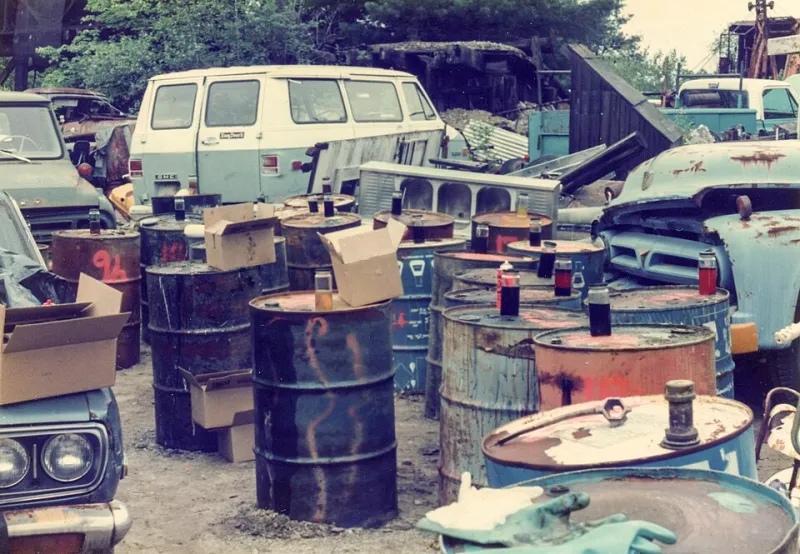
Photo: Massachusetts Dept. of Environmental Protection, CC BY 2.0, via Wikimedia Commons
The Assumption That Costs Money
Ask the owner of an auto repair shop, a community college maintenance department, or a mid-sized furniture finisher whether they are a hazardous waste generator, and the answer is often a confident no. That confidence is frequently misplaced. Under the Resource Conservation and Recovery Act (RCRA), the federal government does not measure a business by its industry, its revenue, or the size of its building. It measures it by the weight of the waste it produces in a calendar month — and the numbers are lower than most operators expect.
A facility that generates more than 100 kilograms (roughly 220 pounds) of hazardous waste in a month, or accumulates more than 1 kilogram of acutely hazardous waste, is classified as a Small Quantity Generator (SQG). For perspective, 100 kilograms is about half a drum of spent solvent. A single month of routine parts cleaning, paint booth cleanup, or laboratory operation can cross the line.
How the Classification Actually Works
EPA rules divide generators into three tiers:
- Very Small Quantity Generators (VSQGs) produce no more than 100 kilograms per month and face minimal requirements.
- Small Quantity Generators produce between 100 and 1,000 kilograms per month and must obtain an EPA ID number, follow accumulation time limits, and train personnel.
- Large Quantity Generators exceed 1,000 kilograms monthly and face the full weight of the program.
The critical detail is that classification is recalculated every month. A quiet February and a busy March can place the same facility in different tiers, and the obligations of the higher tier apply the moment the waste is generated — not when someone gets around to paperwork. Facilities that experience seasonal spikes, one-time cleanouts, or a short-lived production run often discover this rule the hard way.
Where Small Operations Get Caught
Enforcement actions against SQGs rarely stem from dramatic events. They grow out of ordinary, avoidable mistakes:
Misidentifying waste. Spent parts cleaner, aerosol cans, used oil contaminated with solvents, and universal wastes like fluorescent lamps all carry distinct rules. Treating a regulated stream as ordinary trash is one of the most common citations issued during state inspections.
Exceeding accumulation time. SQGs may store hazardous waste on site for no more than 180 days (270 days if shipping more than 200 miles). Drums that quietly sit in a back corner for two years represent a straightforward violation — and, if the contents are ignitable or reactive, a genuine fire risk.
Skipping the contingency plan and training. The rules require basic employee training and a written emergency response outline. Inspectors ask for both early, and facilities without them rarely talk their way out of a notice of violation.
Manifest gaps. Waste shipped off site must travel with a manifest that follows it to a permitted facility. Relying on an unvetted hauler who cuts corners transfers the paper trail — but not the liability — back to the generator. Under the cradle-to-grave principle, the business that produced the waste remains responsible for it even after it leaves the loading dock.
That last point deserves emphasis. Courts and regulators have pursued original generators for cleanup costs decades after disposal, which is why the recent wave of PFAS and solvent-related enforcement has reached companies that merely used a common product in the 1980s.
Compliance Without an Environmental Department
The good news is that SQG obligations are manageable for a business of almost any size. A practical program rests on four habits:
- Characterize every waste stream once, in writing. A one-time assessment by a qualified consultant or a knowledgeable waste vendor establishes what is regulated and what is not.
- Label and date every container. It sounds trivial, but missing labels and dates are among the most frequently cited items in state inspections from Ohio to California.
- Track the calendar. Accumulation clocks, annual determinations, and manifest records should live in a shared compliance calendar reviewed quarterly — the same discipline facility managers already apply to fire extinguisher and elevator inspections.
- Vet vendors. Confirm that any hauler and disposal facility hold current EPA permits and insurance, and keep copies of manifests for at least three years.
For many operations, an annual walkthrough by an environmental services provider costs less than a single month of the fines, corrective action, and legal fees that follow an enforcement action. The EPA's penalty framework treats violations on a per-day, per-violation basis, and a storage violation left uncorrected can compound quickly.
An A1 Standard of Care
The businesses that avoid the small generator's trap share one trait: they treat waste compliance as routine maintenance rather than a crisis response. Classification is understood before the first drum is filled, records are current before the inspector arrives, and contractors are chosen for documented competence rather than the lowest quote.
Federal thresholds are not going to rise to meet anyone's assumptions. The facilities that thrive are the ones that sized up the rules early — and built their housekeeping to match.